

July 30, 2026
An ice maker can fail in more ways than simply “not making ice.” It may produce only a few cubes, create unusually small or hollow ice, leak water, freeze into a solid mass, or appear to complete its cycle without producing anything at all.
Those differences matter.
The questions below cover common ice maker repair concerns and explain what you can safely observe before professional diagnosis becomes necessary.
Quick Summary: Start with the symptom. Ice quantity, cube shape, water behavior, temperature, and timing can all provide useful clues—but none automatically identifies a failed component.
FAQ: Why Is My Ice Maker Not Making Any Ice?
Several conditions can interrupt ice production, so “no ice” should be treated as a symptom rather than a diagnosis.
First, confirm that the ice maker is turned on and that any accessible shutoff arm, switch, or control is in its normal operating position according to the appliance instructions.
Then consider the freezer itself. An ice maker depends on appropriate freezer conditions. If the compartment is not maintaining its intended temperature, ice production may slow or stop even though the ice maker itself is not the original cause.
Water supply also matters. Depending on the appliance, possible diagnostic areas can include the water supply, filter condition, fill system, water valve, ice maker assembly, controls, sensing systems, or other components.
Quick Summary: No ice does not automatically mean the ice maker assembly has failed. Check basic controls and freezer performance first.
FAQ: Why Is My Ice Maker Making Ice So Slowly?
Slow production can be frustrating because the ice maker technically still works—it simply cannot keep up.
Start by asking whether production has actually changed. Has the appliance always produced ice at approximately this rate, or did output recently decline?
If production has changed, consider conditions affecting both freezing and water delivery.
Possible factors may include:
- freezer temperature performance;
- frequent door opening;
- water supply conditions;
- filter condition on applicable models;
- ice maker operation;
- fill-system or control problems.
If the freezer itself is warmer than expected, address that clue rather than assuming the problem exists only inside the ice maker.
Quick Summary: Slow ice production can reflect a freezing problem, water-delivery problem, or ice-maker problem. The production rate alone does not identify which one.
FAQ: Why Are My Ice Cubes Small or Hollow?
Cube shape can provide surprisingly useful information.
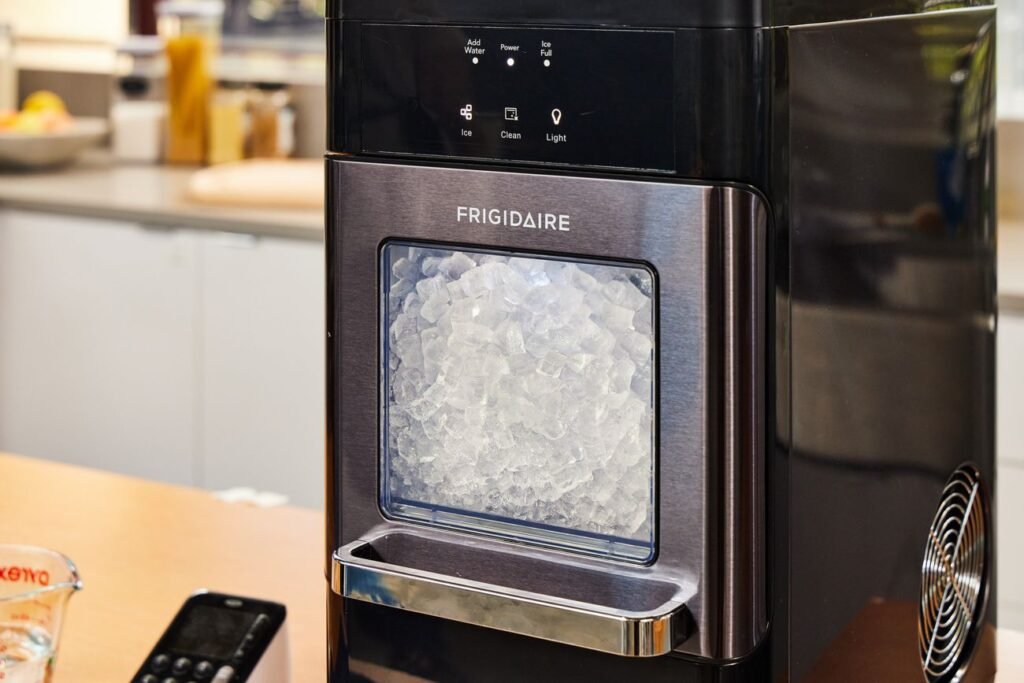
If cubes suddenly become smaller, incomplete, or hollow, the ice maker may not be receiving or freezing the expected amount of water under normal conditions.
That does not automatically mean the water valve needs replacement.
Depending on the model, diagnosis may involve water supply conditions, filtration, the fill system, valve operation, freezer temperature, or the ice maker itself.
If your refrigerator uses a replaceable water filter, check whether it is installed correctly and whether maintenance is due according to the manufacturer’s guidance.
Do not modify water connections or attempt internal valve repairs simply because the cubes look different.
Quick Summary: Small or hollow cubes are a clue about the freezing-and-filling process, not a confirmed component diagnosis.
FAQ: Why Is Water Leaking Around the Ice Maker?
Water where it should not be deserves attention.
First determine where the water appears. Is it inside the ice bin? Beneath the refrigerator? Around an accessible water connection? Is it freezing into sheets or clumps near the ice maker?
The location and timing of the leak can help narrow the diagnostic direction.
Possible causes may involve water connections, fill components, ice accumulation, valve operation, tubing, positioning, or another part of the water-delivery system.
If water is reaching electrical components, stop normal operation and address the safety issue rather than continuing to run the appliance for observation.
Quick Summary: With leaks, location matters. “Water near the refrigerator” is less useful than knowing exactly where it appears and when.
FAQ: Why Is My Ice Maker Making One Large Block of Ice?
Ice cubes that repeatedly freeze together can have several explanations.
If ice remains in the bin for a long time, some clumping may occur under certain conditions. But repeated large masses of ice—especially when accompanied by visible water or abnormal filling—deserve closer attention.
The question is whether water is entering or remaining where it should not.
Observe whether the problem appears after a fill cycle, whether the cubes themselves look normal, and whether there is visible ice buildup around the ice maker.
A technician may need to evaluate water delivery, fill operation, valve behavior, ice maker operation, or other model-specific systems.
Quick Summary: Breaking apart the ice addresses the result. If the problem repeatedly returns, diagnosis should focus on why the excess ice forms.
FAQ: Why Does My Ice Maker Make Noise but Produce No Ice?
Ice makers naturally make some noise while filling, freezing, harvesting, and releasing ice. Refrigerators also contain fans, valves, and other components that can create sounds nearby.
A new or repeated sound becomes more useful when you connect it with what the appliance is doing at that moment.
Ask:
- Does the sound occur when the ice maker should be filling?
- Does it occur when ice should be released?
- Is there any water in the ice mold afterward?
- Is the freezer maintaining normal temperature?
- Did the sound appear at the same time ice production stopped?
You do not need to identify the component by sound alone.
Quick Summary: A sound becomes diagnostically useful when it can be connected to a specific stage of the ice-making process.
FAQ: Can a Refrigerator Water Filter Affect Ice Production?
On refrigerators where the filtration system supplies water to the ice maker, filter condition or installation can be relevant to water delivery.
If ice production changed around the time a filter was replaced, verify that the correct filter is installed properly according to the manufacturer’s instructions.
If filter maintenance is overdue, follow the appliance manufacturer’s replacement guidance.
However, do not assume every ice-production problem is caused by the filter. If symptoms persist after the appropriate basic checks, further diagnosis may be needed.
Quick Summary: The filter can be part of the water-delivery picture on applicable models, but it is only one possible factor.
FAQ: Can Freezer Temperature Affect the Ice Maker?
Yes. The ice maker depends on the freezer environment to complete the freezing process.
If the freezer is not maintaining its intended temperature, the ice maker may produce ice slowly or stop completing normal cycles.
This is why an ice-production complaint should sometimes begin with the freezer rather than the ice maker.
Look for other temperature-related clues. Is frozen food becoming softer? Has unusual frost appeared? Does the freezer seem to run differently than before?
If ice production and freezer performance changed at approximately the same time, mention both symptoms during service.
Quick Summary: Ice maker performance cannot always be separated from freezer performance.
FAQ: Why Does My Ice Maker Keep Freezing Up?
Recurring ice buildup is different from a one-time piece of misplaced ice.
If frost or solid ice repeatedly forms around the ice maker, fill area, or nearby components, simply removing it may provide only temporary relief.
A recurring pattern may require investigation of water delivery, freezing conditions, fill operation, component positioning, or other systems appropriate to the model.
Avoid using knives, screwdrivers, or other sharp objects to chip ice from areas inside the freezer. Concealed components can be damaged.
If defrosting is appropriate, follow the manufacturer’s instructions.
Quick Summary: If the ice keeps returning, the real repair question is not “How do I remove it?” but “Why does it keep forming?”
FAQ: Should I Reset the Ice Maker?
If the manufacturer provides a normal reset procedure for your specific appliance, following that documented procedure can sometimes be an appropriate troubleshooting step.
But repeated resets should not become a substitute for diagnosis.
If the ice maker repeatedly stops working and a reset only restores operation temporarily, that pattern is useful information.
Record what happens before the failure, how long operation returns after the reset, and whether any error information appears.
Quick Summary: A reset may restore operation. It does not necessarily explain why operation stopped.
FAQ: Can I Repair an Ice Maker Myself?
Basic external checks are reasonable when they remain within the manufacturer’s normal homeowner instructions.
You can check controls, observe freezer performance, inspect accessible areas, note leaks, record error codes, and verify appropriate filter maintenance on applicable models.
The boundary changes when troubleshooting requires internal electrical testing, disassembly, water-valve diagnosis, control testing, or work on refrigeration systems.
Never bypass appliance safety systems or perform energized electrical work as a basic DIY test.
If you see smoke, unexpected sparking, a persistent electrical burning smell, damaged wiring, or water reaching electrical components, stop normal operation.
Quick Summary: Observation is DIY-friendly. Internal diagnosis requires a different level of testing.
FAQ: When Should I Call for Professional Ice Maker Repair?
Professional diagnosis makes sense when safe basic checks do not explain a persistent problem.
Consider service when:
- the ice maker consistently produces no ice;
- production has become unusually slow;
- small or hollow cubes repeatedly appear;
- water leaks around the ice-making system;
- ice repeatedly freezes into abnormal masses;
- the ice maker stops and restarts unpredictably;
- the problem requires internal electrical or water-system testing.
Empire Appliances Repair can diagnose ice maker problems involving ice production, water delivery, valves, ice maker assemblies, slow production, leaks, controls, and related refrigerator or freezer conditions.
The objective is to determine why the ice-making sequence is failing before deciding which component, if any, needs replacement.
Quick Summary: Call for professional repair when the symptom persists, repeats, or requires testing beyond safe external checks.
FAQ: Is It Better to Repair or Replace the Ice Maker?
Make that decision after the fault has been identified.
If the ice maker is part of a refrigerator or freezer, consider the condition of the entire appliance—not only the ice-making system.
The confirmed fault, overall appliance condition, repair history, parts availability, and scope of the required work can all influence the decision.
A refrigerator that stops making ice does not automatically need a complete ice maker assembly. Likewise, an ice maker problem does not automatically mean the refrigerator itself should be replaced.
Quick Summary: Diagnose first. Decide between repair and replacement second.
Conclusion: Start With the Ice, Then Follow the Process
Ice maker problems become much easier to understand when you look beyond the simple question, “Why don’t I have ice?”
Is there no ice at all—or just less than before? Are the cubes small? Is water leaking? Is the freezer warm? Does the ice maker make unusual sounds? Does the problem disappear after a reset and then return?
Each answer adds context.
The ice itself is often the first clue. Its quantity, shape, consistency, and the conditions around it can help reveal where the ice-making process has changed.
Perform the safe basic checks. Preserve useful information. Avoid guessing at internal components.
Then, when the problem goes beyond what you can safely observe, professional ice maker repair can turn those clues into an actual diagnosis.